
The stellar periphery of the Magellanic Clouds
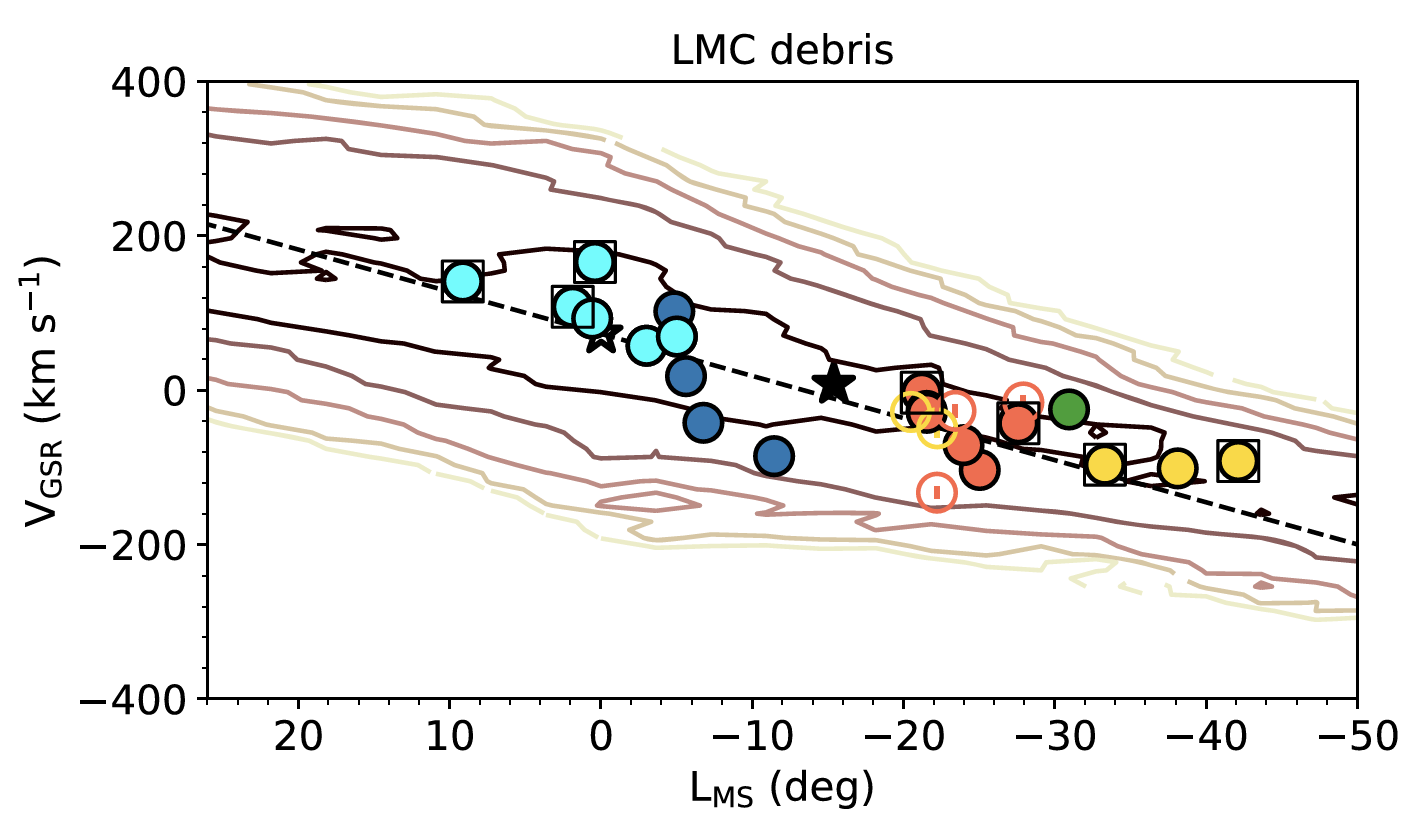 Phase-space distribution for LMC debris, based on the N-body simulations of Jethwa et al. (2016). The BHB stars from Navarrete et al. (2019) are shown as colored symbols. They follow the LMC’s halo velocity trend (dashed line): i.e. all S1 stars and S2, S3, and S4 stars with VGSR < 0 km s-1.
The Magellanic Stream / Magellanic Wake
Globular clusters’ tidal tails
RR Lyrae stars as distance indicators
Through my research, I have studied the metallicity dependence of the near-IR period-luminosity relation of population II variable stars. In particular, as part of my Master’s thesis project, I analysed the VISTA J and Ks light curves and variability of the population of variable stars of the most massive globular cluster of our Galaxy: omega Centauri. Having variable stars detected since photographic plate observations (Bailey et al. 1902), my thesis also involved a detailed analysis of the variable stars catalogue, finding new variables, discarding field stars and identifying some duplicate variables.
In Navarrete et al. (2015, A&A, 577, 99), I studied the RR Lyrae sample of the cluster, showing the dependence of the Bailey diagram and period-luminosity diagram on the metallicity. I also provided calibrated period-luminosity relations for RRab and RRc stars in the J and Ks bands.
In Navarrete et al. (2017, A&A, 604, 120), the calibrated period-luminosity relations for RR Lyrae stars, Type II Cepheids and SX Phoenicis stars in the J and Ks bands were provided. These were the first near-IR calibration of the period-luminosity relation for SX Phoenicis stars.
Related Conference proceedings and Research Notes associated with this work:
- Navarrete et al. (2013), Information Bulletin on Variable Stars, No. 6078, #1.
- Navarrete et al. (2014), Revista Mexicana de Astronomía y Astrofísica (Serie de Conferencias), 44, 161
- Navarrete et al. (2016), Communications from the Konkoly Observatory, 105, 45-48
- Navarrete et al. (2017), Formation, evolution, and survival of massive star clusters, Proceedings of the International Astronomical Union, IAU Symposium, 316, 351
- Navarrete et al. (2017), Wide-Field Variability Surveys: A 21st Century Perspective - 22nd Los Alamos Stellar Pulsation - Conference Series Meeting, San Pedro de Atacama, Chile, EPJ Web of Conferences, 152, 07005